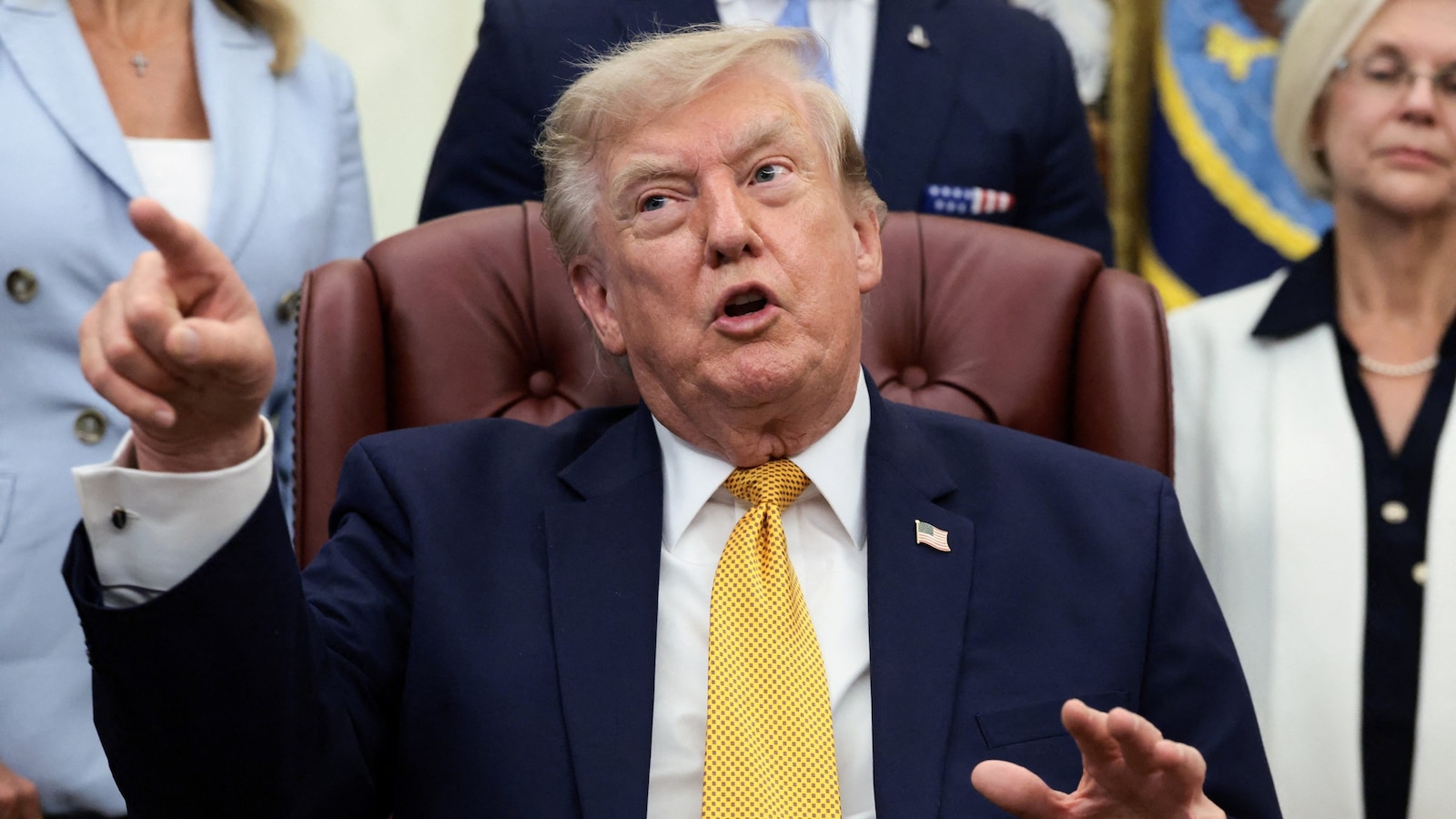
President Donald Trump appears to have a strategy: threaten irreparable damage to Iran’s civilian infrastructure then hit pause and hope the other side decides to come to the table and revive negotiations.
By ABC News’ count, he’s tried it no less than seven times. So far it hasn’t worked.
In what’s becoming a familiar pattern, Trump wrote on his social media platform late Saturday night that at the request of Iran and other Middle Eastern countries he’d decided not to carry out his what White House officials said would be a devastating strike targeting Iran’s energy infrastructure. But, he warned, the U.S. is still “locked and loaded” and prepared for “Military Terror… not seen since [World War II]”

President Donald Trump points his finger as he answers questions from the media after signing an executive order establishing the President’s Military Spouse Commission in the Oval Office at the White House in Washington, August 3, 2026.
Evelyn Hockstein/Reuters
Here’s a look at the times Trump has made similar threats over the course of the five-month war.
1. Trump threatens Iran’s power plants but backs off two days later
The threats started a little less than a month into the war, on March 21, when Trump said he’d attack Iran’s power plants if the Strait of Hormuz was not fully opened. “The United States of America will hit and obliterate their various POWER PLANTS, STARTING WITH THE BIGGEST ONE FIRST!” he wrote on social media.
But just two days later he announced that progress was being made and that the strikes were postponed for five days. “BASED ON THE TENOR AND TONE OF THESE IN DEPTH, DETAILED, AND CONSTRUCTIVE CONVERSATIONS, WHICH WILL CONTINUE THROUGHOUT THE WEEK, I HAVE INSTRUCTED THE DEPARTMENT OF WAR TO POSTPONE ANY AND ALL MILITARY STRIKES AGAINST IRANIAN POWER PLANTS AND ENERGY INFRASTRUCTURE FOR A FIVE DAY PERIOD, SUBJECT TO THE SUCCESS OF THE ONGOING MEETINGS AND DISCUSSIONS,” Trump wrote.
2. Power plant strike delayed again
After the five days elapsed on March 26, Trump paused the planned strikes for another 10 days, citing requests by the Iranian government.
“As per Iranian Government request, please let this statement serve to represent that I am pausing the period of Energy Plant destruction by 10 Days to Monday, April 6, 2026, at 8 P.M., Eastern Time. Talks are ongoing and, despite erroneous statements to the contrary by the Fake News Media, and others, they are going very well. Thank you for your attention to this matter! President DONALD J. TRUMP.”

President Donald Trump listens to questions from reporters during a Cabinet meeting at Camp David, the presidential retreat, July 31, 2026 in Camp David, Maryland.
Aaron Schwartz/AFP via Getty Images
3. ‘A whole civilization will die tonight’
On the morning of April 7, Trump wrote in a social media post that “a whole civilization will die tonight, never to be brought back again.” He said strikes could be averted if “less radical minds prevail” in Iran. Then, 10 hours later on the evening of April 7, he called off the strikes and said the two sides had agreed to a two-week ceasefire. In that social media post, he said the two-week period would allow for a peace agreement “to be finalized and consummated.”
4. Trump announced indefinite ceasefire
When no deal was reached after two weeks, the president decided to hold off strikes further and announced an indefinite ceasefire. On April 21s he wrote: “Based on the fact that the Government of Iran is seriously fractured, not unexpectedly so and, upon the request of Field Marshal Asim Munir, and Prime Minister Shehbaz Sharif, of Pakistan, we have been asked to hold our Attack on the Country of Iran until such time as their leaders and representatives can come up with a unified proposal. I have therefore directed our Military to continue the Blockade and, in all other respects, remain ready and able, and will therefore extend the Ceasefire until such time as their proposal is submitted, and discussions are concluded, one way or the other. President DONALD J. TRUMP

Women walk past a banner showing portraits of the late Iranian revolutionary founder Ayatollah Ruhollah Khomeini (L), Supreme Leader Ayatollah Mojtaba Khamenei (C), and the late Supreme Leader Ayatollah Ali Khamenei, under a bridge in northern Tehran, Iran, on Aug. 2, 2026.
Vahid Salemi/AP Photo
5. Trump forecasts ‘major attack,’ calls it off the next day
Nearly a month went by with little progress. On May 17, Trump injected new urgency into the negotiations, saying “the Clock is Ticking” and threatens there will be “nothing left of them” if Iran doesn’t “get moving, FAST.” On May 18, he told reporters he was planning for a major attack the next day, but decided to “put it off for a little while, hopefully maybe forever, but possibly for a little while, because we’ve had very big discussions with Iran.” Soon after he posted on social media he’d been asked by Iran and Gulf leaders to hold off on his planned attack. But, he warned, he was “prepared to go forward with a full, large-scale assault of Iran, on a moment’s notice, in the event that an acceptable Deal is not reached.”
6. Trump considers ‘massive attack,’ but holds off at the advice of senior administration leadership
Weeks of talks lead to a 14-point memorandum of understanding with Iran and a ceasefire signed on June 17. By July 8 the agreement falls apart and on July 11 the Trump administration resumes targeted attacks on Iranian military targets for 13 straight days. On July 23 Trump told Axios he was “considering a massive attack” that will be “bigger than ever before.” He said he was “close to making a decision.”
But by July 27, following reports that he’d been advised by senior leadership to hold off, Trump told reporters he was working on negotiations instead. “They want to meet, and we’re meeting, Trump said traveling on Air Force One. “We’ll see what happens.”

Smoke rises after reports of multiple U.S. strikes on the city in Ahvaz, Khuzestan Province, Iran, July 30, 2026.
Social Media via Reuters
7. Trump calls off major strikes on Iran’s energy infrastructure
Hostilities had resumed once again following a surprise missile attack aimed at U.S. forces in Jordan. The Defense Department responded with strikes on Iranian military targets on July 29. The next day, reports surfaced that the administration was considering a large-scale attack on Iran’s energy infrastructure. Just over 24 hours later, on the evening of Aug. 1, the president posted he would “hold off” at the request of Iran and other Middle Eastern countries. He said the “U.S.A. is locked and loaded and ready to go against the Islamic Republic of Iran, at levels of Military Terror, Strength, and Power not seen since World War II.” But, he added, he will “cancel the attack, subject to being able to make a DEAL.”
Iran soon after denied that any talks with the U.S. were happening.
On Monday, Trump told reporters this was Iran’s “last chance before decapitation.”