One day in late May, Greg Gatwood was doing what he does best as a design landscaper — grading his backyard and leveling the soil. Gatwood hoped to put in a new fence and was raking some rocks and dirt to make the yard smoother.
As the 65-year-old was using a pickax to remove what he thought was a rectangular piece of concrete, the object moved.
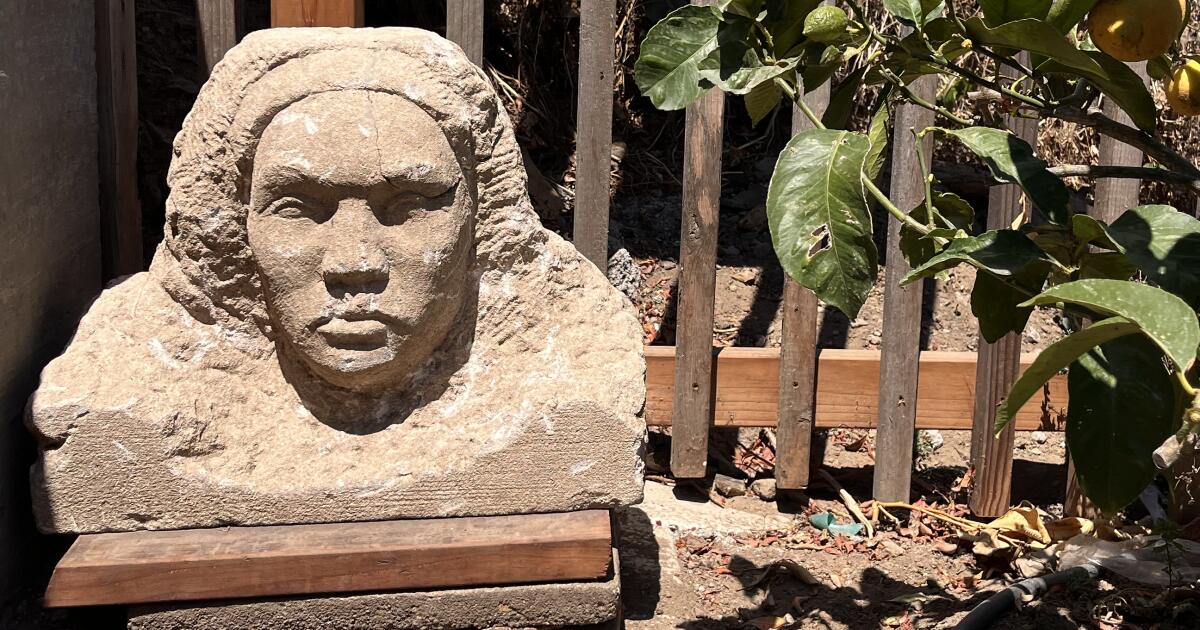
Puzzled, Gatwood lifted the big block and flipped it over to reveal it was a very large bust of a woman, weighing about 150 pounds.
“I’ve always thought every yard deserves a nice piece of garden art,” Gatwood told The Times. “This will be displayed in a special way in our yard. I hope to share the photos of our yard when it’s completed with the statue beautifully placed.”
His wife, Judy Gittelsohn, 68, was sitting inside their San Francisco home in Russian Hill working when she noticed her husband’s discovery.
Gittelsohn, a painter who attended the now-shuttered San Francisco Art Institute in the 1970s, located across the street from the couple’s home, reached out to about 50 scholars and art experts about the origins of the bust.
She learned that the bust likely could have belonged to one of the students of Ralph Stackpole, a sculptor who taught at the San Francisco Art Institute (then known as the California School of Fine Arts.) Stackpole joined the faculty in 1918 and taught there until 1941.
“The thrilling part is the investigation and how many people are so excited about this,” Gittelsohn said. “You find a treasure and it’s just like the world is sort of opening in this way. We knew Ralph Stackpole’s canon of work but we didn’t know how many people he taught and how many people’s lives he’s touched. I’m a painter and it’s a fantastic big book opening.”
The bust is about 22 inches wide, 18 inches high and 10 inches deep, according to the couple. They also did an assessment and concluded the statue is most likely limestone.
The statue could be from the Golden Gate International Exposition, which was a World’s Fair held at Treasure Island in 1939, according to the couple.
“The likelihood is that it was made in the 1930s because of the style of execution,” Gittelsohn said. “It’s pretty typical of the 1939 exhibition on Treasure Island. Ralph Stackpole had a studio and home down the street and he brought in painter Diego Rivera and they created these styles of sculptures.”
The couple isn’t planning on getting the bust appraised due to the high cost of the service. They also aren’t planning on selling the statue. In the meantime, Gatwood is continuing his yardwork — now around the statue.
“Greg has worked in many yards and a couple of our own and this has been the biggest find,” Gittelsohn said. “People are fascinated. It’s a real sweet gift.”
Anne Schnoebelen, a historian and vice president of the board of directors for the Treasure Island Museum in San Francisco, said that there isn’t any evidence yet linking the statue to a specific artist or time period.
But she said if she had to guess, she would say the bust is from an area of the 1939 World’s Fair on Treasure Island called “The Court of Pacifica,” which featured an 80-foot statue of the goddess “Pacifica” by Stackpole.
“The Court of Pacifica” also included a fountain of 20 other sculptures representing the Pacifica community.
Schnoebelen said that the sculpture could’ve been created by Adaline Kent, Helen Phillips or Sargent Claude Johnson, whose sculptures were displayed at the World’s Fair.
An expert could analyze the individual brushstrokes on the statue to identify the exact origins of the bust, she said.
“There’s a sophisticated method to examine the strokes to examine how it was made and what kind of tools were used,” she added. “I just think that when sculptures are known for doing that kind of work, experts can determine who did what.”
Schnoebelen said that while the speculating on the origins of the statue is all conjecture at this point, she does enjoy the attention the statue has brought to this particular period of art.
“I love that it’s bringing attention to something that I care about very deeply,” she said. “I appreciate that Judy and Greg have added that to the mix of possibility. It looks like it could’ve been one of the faces made for the ‘Court of Pacifica’ but we don’t know.”
The San Francisco Art Institute closed in 2022 and was purchased by a nonprofit in 2024, with the intention of turning it into the California Academy of Studio Arts, which will offer 30 visual artists a free one-year residency.