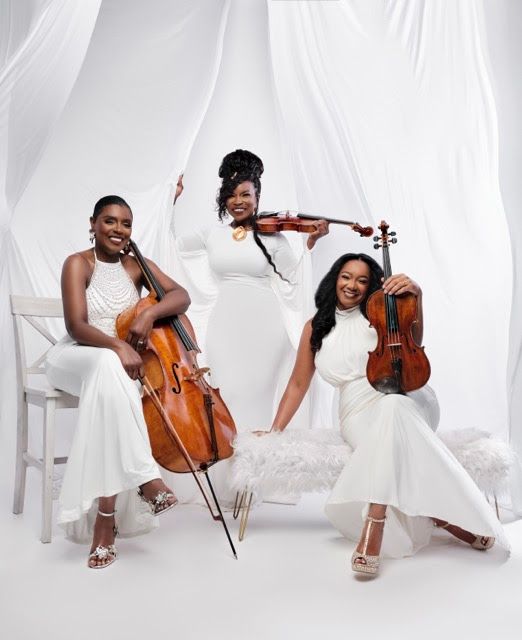
This mid-summer stretch has always been a time of dual consciousness. We simultaneously celebrate the hard-won victories of our freedom while navigating the glaring, systemic, and often turbulent realities of our present. It is a season that begs us to look inward and ask a fundamental question: What does liberty actually mean when the ground beneath us still feels so fundamentally unstable? If you are looking for an instrumental soundtrack to help untangle that very question, look no further than the Washington, D.C.-based string trio, The String Queens.
Comprised of violinist Kendall Isadore, violist Dawn Johnson, and cellist Élise Sharp, this dynamic force of Black womanhood has spent nearly a decade captivating audiences nationwide. They have built an esteemed reputation for bridging the gaps between classical virtuosity, jazz, gospel, blues, and contemporary R&B. On Juneteenth 2026, the trio stepped boldly into a brand-new chapter of their legacy. They unveiled their first-ever original composition, “Troubled Liberty,” the powerful lead single from their highly anticipated album, What We Carry.
When the trio recently spoke with MadameNoire, their warmth, intellect, and collective brilliance were immediately palpable. They are women who wear many hats— touring musicians, wives, mothers, and dedicated educators. Yet, when they pick up their instruments, they become musical storytellers. In “Troubled Liberty,” they have created a gorgeous, haunting, and ultimately triumphant dialogue about what it means to be Black, free, and watchful in America today.
RELATED CONTENT: Black Music Month: Meet Sherie, The Singing Violinist Blending R&B, Healing And Heartbreak [Exclusive]
The Push to Create
For nine years, The String Queens built a stellar reputation as masters of arrangement and fusion. They could take an Earth, Wind & Fire anthem, a classical concerto, or a contemporary pop hit and make it feel as though it was always meant for a violin, viola, and cello. Despite their talent and bond, the transition into writing and releasing original music was a threshold they hesitated to cross.
“Even before this particular year, there was something that was forming in us individually and collectively that said we needed to release some original music,” Kendall Isadore recalls. “We thought about it, we’d been a group for nine years, but we were kind of on the edge of, like, ‘we should release it, we should write something,’ but we wouldn’t just teeter over that edge.”
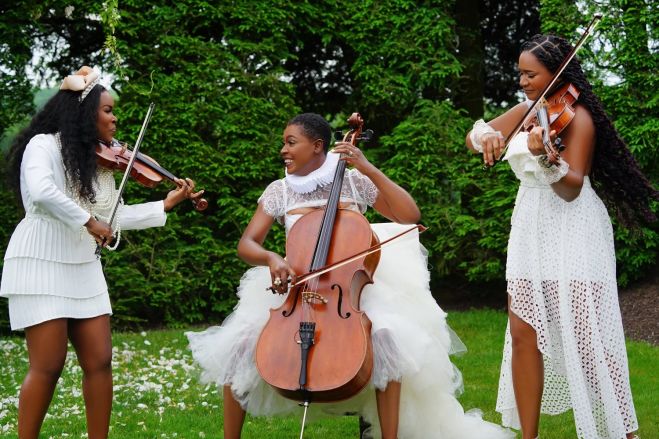
The catalyst they needed arrived in the form of a gentle but firm push from the legendary jazz violinist and National Endowment for the Arts (NEA) Jazz Master, Regina Carter. Carter, who has long pioneered the path of genre-defying string artistry, gave them the ultimate green light.
“She just said, ‘just do it,’” Isadore says. “Like, something so simple as just try it, just jump out there. You all have everything that it takes to make an original piece of music. Anything you release is going to be powerful, because you all are intentional and thoughtful in your message. She was pushing us… She said, ‘you already booked the studio time. When you go in and the engineer hits record, yeah, do what you plan to do, and then just do whatever comes to mind in the moment.’”
Armed with Carter’s blessing, the trio went to work in the most intimate of spaces: Dawn’s basement.
“We said, ‘okay, we’re gonna do it now. Like, what does this feel like? What do we want it to sound like?’” Isadore explains. Around the time of the song’s conception, the film Sinners had recently captured the cultural imagination. The raw, ancestral weight of that project’s imagery, storyline, and music resonated deeply with the trio. “We as musicians are also storytellers. And so, the past and the ancestry of it all, we knew we wanted to create something that paid homage to our ancestors, paid homage to our family, our parents, something that also the young people could relate to.”
Anatomy of a Masterpiece
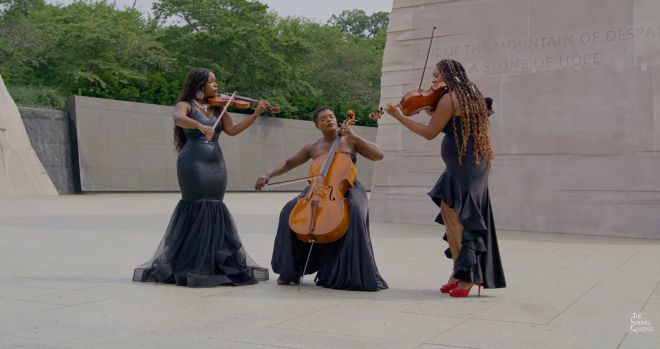
“Troubled Liberty” demands your full emotional presence. The composition opens with a striking, 13-second audio clip from the late, incomparable poet, author, and activist Nikki Giovanni. In the recording, Giovanni likens The String Queens to the groundbreaking Black women of NASA—Katherine Johnson, Dorothy Vaughan, and Mary Jackson—whose brilliance and mathematical calculations made America’s early space missions possible.
“I found that comparison to be very powerful, not just me, our entire group did,” says Dawn Johnson. “And that’s why we decided collectively to include that to the opening of the album, because it really set the precedent and made a statement. This is the launch pad for the artistry that we want to reflect, the sound that we want to reflect in who we are as string players and as Black women.”
Once Giovanni’s voice fades, the musical storytelling begins, constructed with deliberate, technical brilliance. Cellist Élise Sharp describes the song’s foundation, which starts with a drone that anchors the entire piece.
“It started with just a drone,” Sharp explains. “There’s something about a drone. A drone is like a dirge. It kind of centers your piece. It centers your emotion. It started with just a double-stop drone, and then Dawn and Kendall come in with these beautiful lyrics—lyrical playing.”
Over that somber drone, Isadore introduces a haunting rendition of “My Country, ‘Tis of Thee,” completely recontextualized in a minor key. Before the listener can fully process the melancholy of that patriotic melody, Dawn Johnson weaves in the historic Negro spiritual “Wade in the Water”. The result is an intentional juxtaposition of American idealism and the heavy, ancestral survival strategies of enslaved Black Americans.
The song, however, does not wallow in despair. Suddenly, the tempo shifts dramatically, accelerating into a relentless, driving pace.
“The listener feels themselves being called to something,” Isadore describes. “And then we come in and change the tempo completely and now you hear almost a running pace. You hear like a relentless, ‘I’m running.’ It’s like, are you running from something? Are you running to something? It kind of begs the listener to examine everything about it, but I think there’s this middle section, which I’ll call a bridge, that is really the hope of it all. You know, you have this sad and despairing cry of ‘Wade in the Water,’ and this ‘My Country, ‘Tis of Thee’ that doesn’t really sound very joyful. But it’s this hope of, you know what, the world is what it is right now, but it won’t always be this way.”
What We Carry
As the summer of 2026 progresses, the anticipation for their full-length album, What We Carry, continues to build. The project promises to be a genre-defying trip through sound, memory, and identity, honoring the legacy of Black women musicians while embracing the fullness of the human experience.
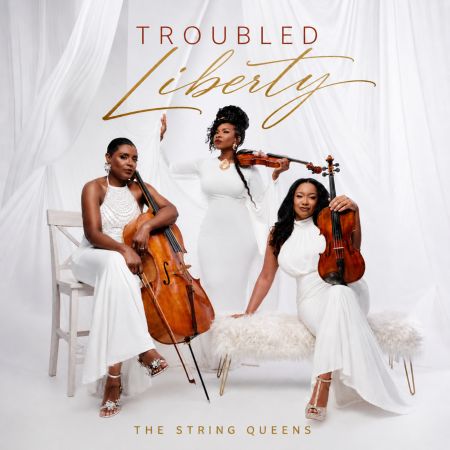
Ultimately, The String Queens view their music as a vessel for deep, spiritual healing—a safe haven where listeners can completely release the heavy weights of the world, if only for 90 minutes.
“I love when listeners are able to just sit in one of our shows for 75 to 90 minutes… and completely forget about every care in the world, completely forget about everything that’s going on in their lives outside the walls of this space that we’re in, because this space becomes more than brick and mortar,” Dawn Johnson reflects softly. “It becomes a spiritual connection between every single person in the room.”
She recalls the emotional interactions they often have during their post-show meet-and-greets.
“We have had interactions with audience members who have literally been to our shows, and that has been the first time that they have left their house in months, some over a year, due to the loss of a spouse, of a child, of someone very close to them,” Johnson shares. “And it was the lost loved one who had told them about The String Queens. And so, when we’re able to be and share in that space with people like that, and for just that hour and a half they can forget about every care in the world, and they can reconnect spiritually with their loved one, reconnect with the music… That’s what I love about our shows. We want to take this little spark that we have and the gifts that God has blessed us with and pass them on to someone else who can pass it on to someone else. And that’s how we want our sound and our mission and our love and our message to spread across the world.”
As “Troubled Liberty” makes its way into the world, it reminds us that we do not have to choose between acknowledging our pain and holding onto our hope. Through strings and infinite soul, The String Queens are showing us how to carry both.
RELATED CONTENT: Dear Black Music Month: A Love Letter To The Healing Power Of Songs